
To date, my science outreach work has focused on creating interactive educational demos and activities to teach concepts from chemistry and provide informal science literacy education opportunities. These demos attempt to give participants the chance to look at a problem solving using the lens of science. Whenever possible, my outreach also emphasizes building hypotheses and evidence-based argument.
Many scientists study microscopic organisms and chemicals, things that are by definition too small to be seen with the naked eye. Ever wonder how the tools we use to study microscopic things get made? This science demo, which I call my modifiable machine or my protein racing game, was built in winter 2017. I currently use it in informal science education events at the Pacific Science Center (who provided both funding and science communication training). The design is based on several experimental techniques from separations science (the science of sorting chemicals from each other based on some characteristic difference like shape or size).
This section contains designs to build the machine, a brief description of how the demo works and what sort of separating machines they mimic, and ideas for additional experiments that can help illustrate how machines separate chemicals.
With just the information in this section, the demo can easily be used in a presentation/demonstration format. If you’re interested in using this demo as an open-ended activity to facilitate problem-solving and science literary skills but are new to the informal education thing, I highly encourage you to read the next section. There, I discuss the design and communication decisions I made while developing the demo, and provide some suggests for adapting the demo for your own needs.
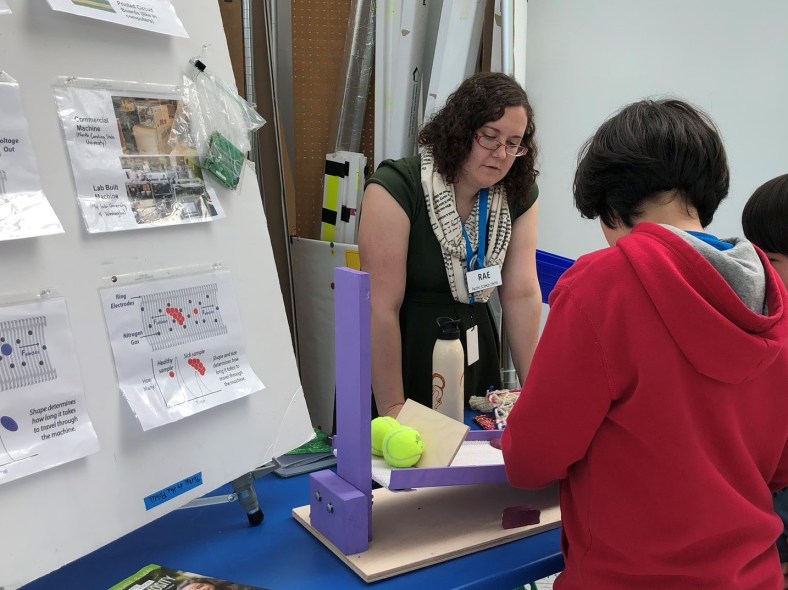 The modifiable machine game in use.
A Scientist and Communicator on Science Communication: a case study designing science communication tools for informal science education
Science is an incredibly useful tool for understanding the world around us, but at the end of the day it’s still a lens we choose to use. Without teaching kids enough science to get them into a laboratory, can we still develop opportunities for them to see a problem through that scientific lens?
This section details the design and communication choices I made while building and testing the my modifiable machine game. Using broad principles I learned from the Science, Technology, and Society Studies program at my university, I worked to make an open-ended game that I believe gives children (and adults) an example of what it means to think scientifically. In particular, kids playing this game are introduced to key scientific concepts such as measurement uncertainty (experiment reproducibility) and experiment design (modifying the machine in a step-wise fashion to achieve their design goals).
 Rae Eaton