This section goes into the basic set-up (which I refer to as sample 1). If you’re looking for building designs or suggested samples/modifications to use, follow those links.
The sample 1 demo is used to illustrate how balls of the same weight can be separated based on differences in their size. I call it the basic set-up because it is the one that most closely resembles my research (more details below) and it requires only the basic machine and some clay (to make sample 1).
The machine is designed to release balls from a starting position and allow them to roll down a ramp to the plastic bin at the bottom (which I’ll refer to as the ending gate or detector). The ball that reaches the bottom first is the winner. The goal of the game/demo is to change the machine to fix the outcome of the race so that one ball always wins and the other always loses.
- Set up your machine as shown in the picture below (instructions here).
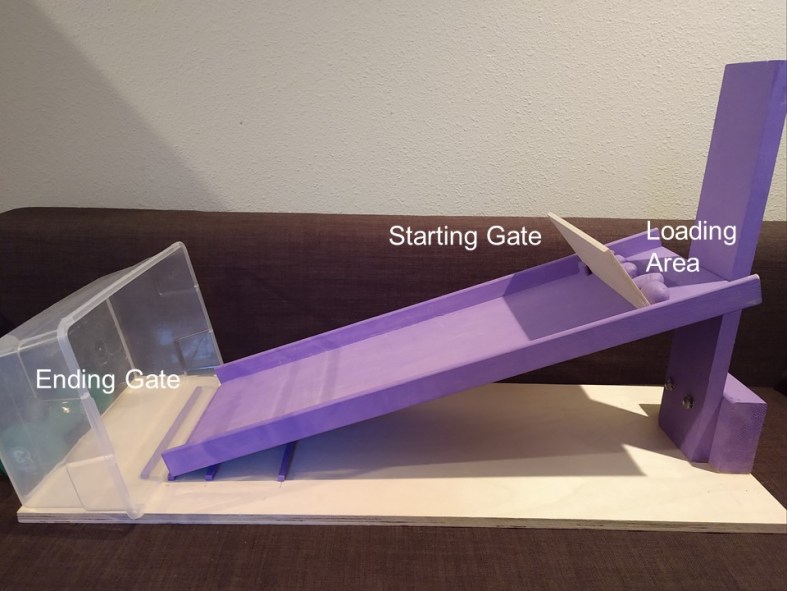
Rapidly pulling the wooden starting gate (held between grooves at the top of the ramp) will release any balls held behind it (the faster the gate is pulled out of the way, the more likely it is that all balls will start rolling at the same time, decreasing the likelihood of unintentionally biasing the race). - Next, ask your audience take a look at the balls in sample set 1. Ask them what they notice that is similar or different between the balls.
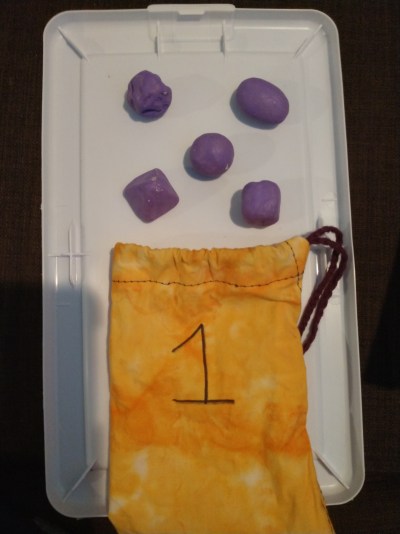
Most people will talk about differences in shape; some will talk about differences in size. If possible, have people compare the size/weight of the balls by holding them in their hands. - Set up the balls in the loading area of the ramp. Explain that when the starting gate is pulled out of the way, the balls will roll down the hill to the plastic bin. Ask at least one person to watch the end of the bin and call out the order the balls arrive there.
- Run the race. (Optional but encouraged: ask audience to make an informed guess about the outcome, based on what they know about the balls.
- Discuss with the audience what ball finished first, last, etc. Given that a lot of the balls roll at roughly the same rate down the ramp, there probably won’t be much agreement. Even if there is agreement, ask them if they would like to run the test a second time, to confirm that the order stays the same.
Discuss the results of running the race twice. (Optional but encouraged: ask the audience if they think you’d get the same result each time if you did the test ten more times.) - Now tell them that you’re going to change the machine to make the results of the race easier to see. Lower the height of the ramp. Run the test again.
- Ask the audience how changing the height changed the result of the test. Did it change who won the race? Did it make it easier for them to see who won?
At this point, I’ll ask my audience to think about why some balls roll down the hill faster than others. We’ll then talk about how differences in shape determine how easily a ball can roll. After that, if my audience seems interested, I’ll bring up how separating balls by shape actually happens in my research.
What type of separation does this example illustrate?
Rolling balls of different shapes down a ramp is reminiscent of many separation instruments used in to physically separate objects from each other. My current area of research, ion mobility, is a good example of this type of scientific machine. If you’ve ever had your bag swabbed for explosives by security agents at an airport, then you’ve encountered an ion mobility instrument in the wild.
Ion mobility is used to separate objects based on differences in size, shape, and charge (how responsive it is to an electric field). Charged objects are called ions, hence the name ion mobility; something that is small, round, and/or highly charged will move easily through the machine (is a very mobile ion). All objects must have a charge to move through an ion mobility machine, since the machine uses an electric field to move everything around. As you can see in the image below, circular metal electrodes (the grey arcs) are used to create the electric field (the sloped purple line). The space within the electrodes is filled with some type of gas (the black spots in second of the two images below). The most common gas used is air.
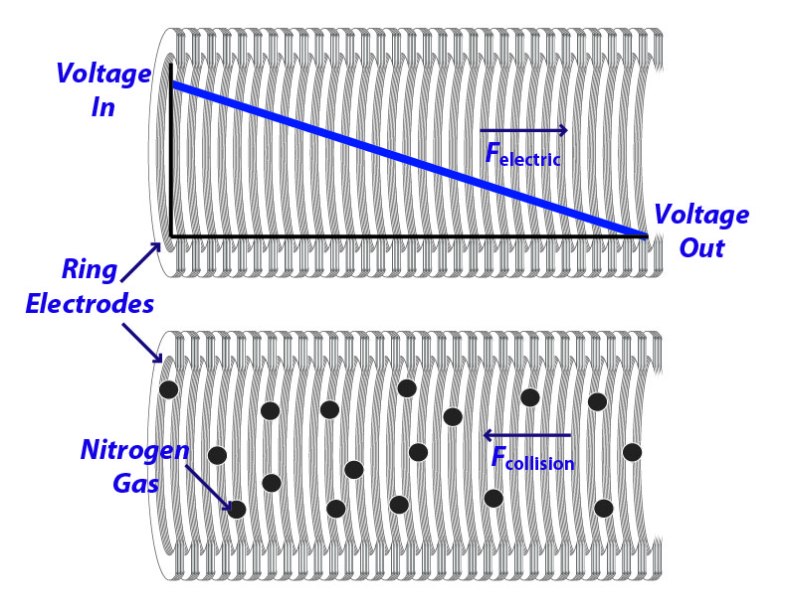
Ions are released by a starting gate and into the electric field. The electric field acts like a ramp, providing a force that pulls ions towards the other end of the electrodes, where a detector is located to look for ions. As the ions move along the electric field, they will occasionally collide with one of the molecules of gas, which slows the ion down. Since ions that are less spherical or larger will collide with gas molecules more frequently, they will move more slowly along the electric field and arrive at the detector later (as can be seen in the image below). It’s important to remember that the detector see an object in the way we do; it only notes that an ion has hit it, and cannot provide any sort of characteristic information on the object.
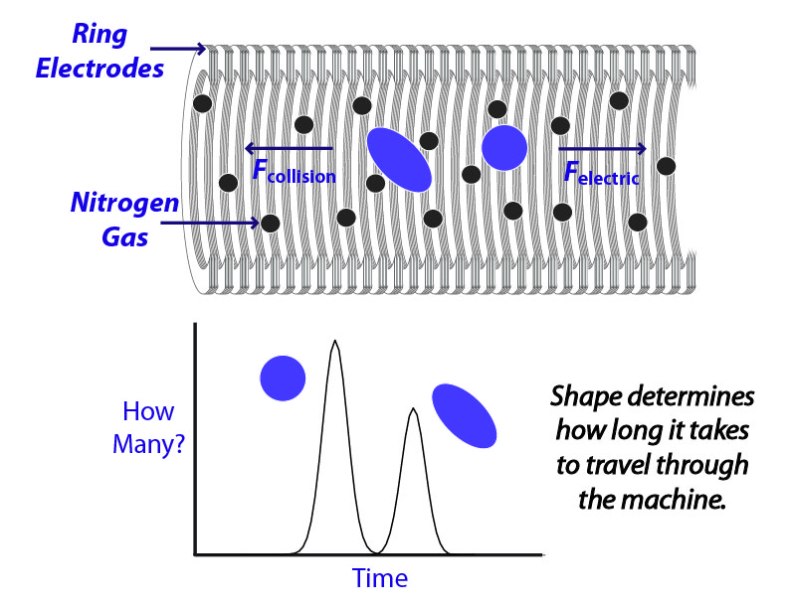
Using the demo with sample 1 provides a fairly good simulacrum of ion mobility. Balls that have non-spherical shapes will not roll as easily down the ramp and will hit the plastic bin after more spherical balls. (The physics of why have a lot to do with friction and the distribution of mass within the rotating shape, but don’t correlate well to the science of ion mobility separations.) By changing the height of the ramp, the acceleration of each balls is either decreased or increased proportionally, which makes the order in which they hit the ending gate harder or easier to spot. Unlike other samples/modifications, the example discussed here cannot produce a change in the ball order.
 Rae Eaton