If you’re like me and you’re not the most extroverted individual, making the physical design of your demo can help bring your target audience to you. Certain physical design choices can also help you achieve the goals of your demo. When I set out to build my modifiable machine, I knew I wanted a design that would lend itself to open-ended exploration and be visually appealing to young women (my target participants). This section briefly discusses the changes I made to accomplish these goals. All of the physical elements of my demo are well-describe in my additions section.
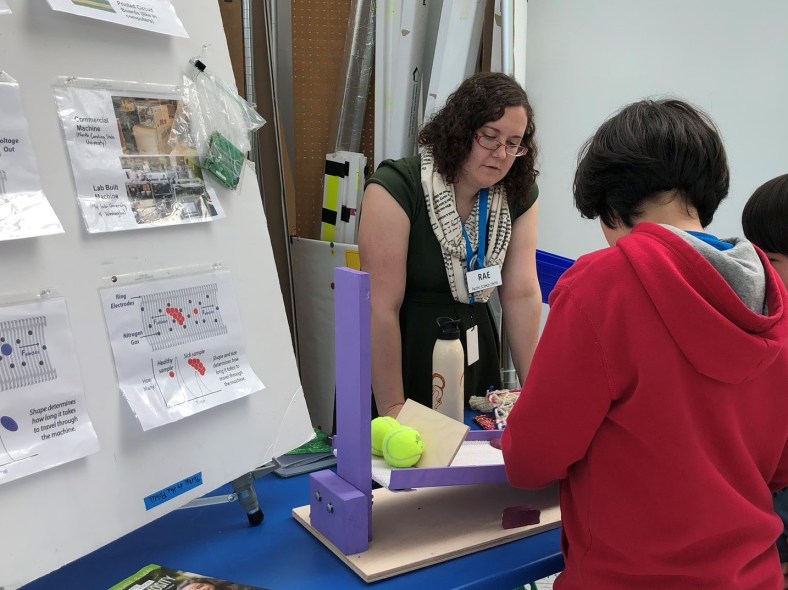
The machine in action
Goals
Like in my communication section, I created a set of goals that I drew on when designing my machine:
- Make a machine that can be physically modified to change the outcome of the results
- Make aesthetic choices that would make the demo visually attractive to younger kids
- Create additional samples and modifications for the demo that would support open-exploration and play
It’s possible that these goals will not resonate with you and you’ll want to make your own. If you’re new to making goals for an outreach activity, I made this quick guide that I hope will help you as you create goals for this or another outreach activity you do.
Physical Designs for a Target Audience
The first thing I addressed was the physical design. For that, I thought deeply about what appealed to me when I was an eight-year-old girl and wanted to build machines (but was too afraid to tell anyone). Many young women like colorful and cleanly assembled designs. As such, I took the time to carefully assemble my machine. I painted my ramp and clay balls purple and sewed bags to hold my sample balls from bright orange fabric. Additionally, the fabric I used to make ramp covers had bright, colorful elements and I incorporate a lot of knitting and crocheting into my design. Even you cannot make knitting or crocheted objects by hand, you can often find suitable alternatives at a craft store.
For your target audience, a purple ramp and bright orange bags might have the wrong impact. If you know what audience you want to target, you can look up good elements of design for that group online. When in doubt, if you can discuss your visual design with other communicators, you will often find what design elements will draw in your target audience.
Physical Designs for Open-ended Exploration
The easiest way to make my demo more open-ended was to provide choices for my participants. I did this by creating three sample sets of balls that can be tested and three surfaces for the ramp. Fortunately for me, the area of science I was modeling with my modifiable demo, separation sciences, is comprised of many different types of machines. This meant that I had many different types of machines and samples that I could draw from when creating my different sample sets of balls and changes that could be made to the machine.
If you are using my demo, I encourage you to use my sample sets and ramp covers. For a different demo, it’s helpful to consider the research you’re attempting to model. If you’re modeling a method for analyzing a specific object (say, DNA), are there alternative methods for getting the same information? Or, are there multiple things one particular method can analyze? By looking for already researched alternatives, you can often find inspiration for additions to your demo. And of course, there are many communication choices you can employ to make your demo more open-ended.
 Rae Eaton